Largactil: What Happens After a Drug Appears to Work?
August 26, 2026

Growing up in Benin, I saw people live with diseases that many in North America have likely never heard of. Seriously, have you heard of river blindness or Buruli ulcer? Both remain endemic in Benin. I have stayed involved in healthcare and education there, but my professional work has mostly lived in preclinical development: molecular design, representation learning, perturbational biology, virtual cells, and related problems. We ask whether a molecule works, whether it is selective, whether it reaches the right tissue, and whether some mice remained reassuringly alive. If it survives those questions, it may reach clinical trials and approval.
Then what?
I had rarely wondered about that question until my wife, a psychiatrist, finished a call with one of her patients and told me she was renewing a prescription for Largactil. Surely, I said, there are better antipsychotics by now. My preclinical brain had obviously turned this into an optimization problem and missed the fact that her patient needed a prescription that worked for them. They had tolerated a newer atypical antipsychotic poorly and, more importantly, chlorpromazine was dirt cheap. In my field, we often forget that:
A drug enters a life already in progress.
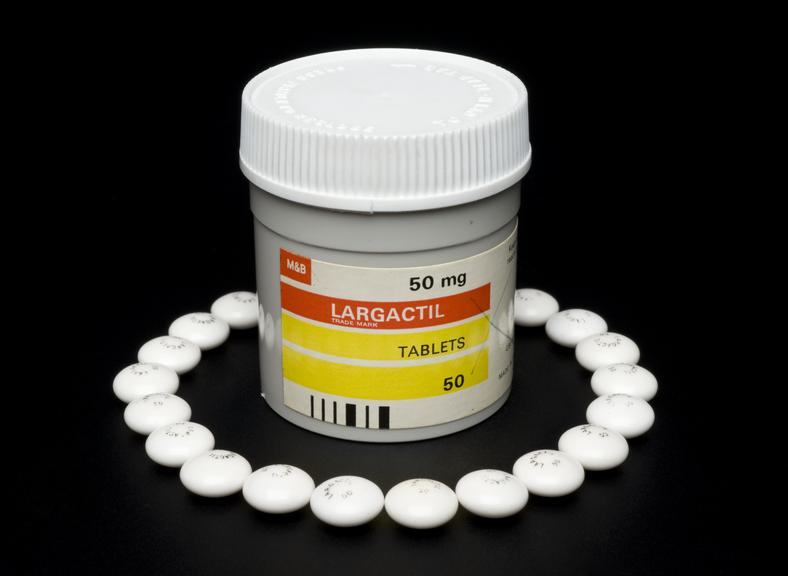
This is exactly what I want to explore in Beyond the Assay, a series about drugs that changed medicine in ways few could have anticipated at the time, and what their stories might teach us about drug discovery in the age of AI. The conversation with my wife gave me a place to start: chlorpromazine (CPZ), the first widely used antipsychotic, still sold in French-speaking countries under the brand name Largactil. Chlorpromazine could reliably reduce hallucinations, delusions, agitation and disorganized thinking for some patients, in ways existing treatments could not. It's not an understatement to claim it changed what everyday psychiatric care could achieve.
An antihistamine looking for a new job
Chlorpromazine’s story is impossible to tell without bringing up phenothiazine chemistry. Phenothiazine is a three-ring scaffold containing one sulfur and one nitrogen atom. Chemists first encountered this family through synthetic dyes, then made antiseptics and antiparasitic agents from it. By the 1940s, Rhône-Poulenc chemists were modifying phenothiazines to make better antihistamines, drugs that blocked histamine in allergic reactions and could also help sedate patients before anaesthesia. Turning that chemistry into a psychiatric treatment would require the uncoordinated effort of a chemist, a pharmacologist, a surgeon and obviously several psychiatrists.
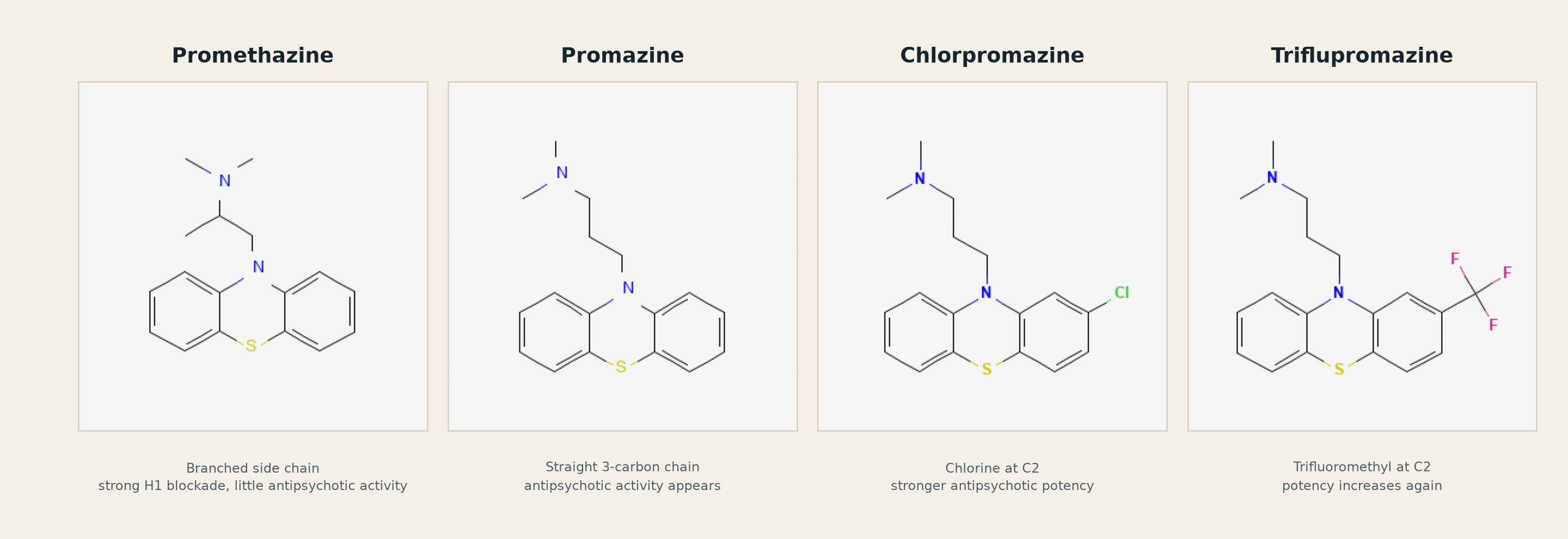
In December 1950, the chemist Paul Charpentier synthesized a chlorinated phenothiazine known inside the company as 4560 RP. Rhône-Poulenc was looking for a better antihistamine and a useful anaesthetic adjunct. The compound proved disappointing at the first task and much more interesting at the second.
Charpentier sent 4560 RP to the pharmacologist Simone Courvoisier for animal testing on the day it was synthesized. Her team spent months mapping an unusual pharmacological profile. In one experiment, rats learned to climb onto a platform when a sound warned of an impending electric shock. After 4560 RP, they stopped reacting to the warning, yet still escaped when the shock itself came. In other tests, the drug reduced spontaneous movement, produced cataleptic immobility and altered responses to adrenaline. By late 1951, Rhône-Poulenc researchers had also found that it could block apomorphine-induced vomiting in dogs. Animals that took the compound remained responsive, but behaviours linked to anticipation, motivation and conditioning seemed to weaken.
From surgical shock to psychosis
That unusual pharmacology caught the attention of Henri Laborit, a French naval surgeon looking for ways to reduce surgical shock, a dangerous physiological response to major operations. In his experiments with “artificial hibernation”, he combined cooling with antihistamines and other drugs to blunt the body’s response to surgery. When he tried chlorpromazine, he noticed that patients became calm and strikingly indifferent to what was happening around them, while remaining conscious. He suspected that this peculiar mental effect might be useful beyond the operating room and urged his psychiatric colleagues to try it.
On 19 January 1952, a 24-year-old man identified as Jacques L. received chlorpromazine at the Val-de-Grâce military hospital in Paris. His severe agitation improved. The result was promising, but also badly confounded: chlorpromazine was given intermittently and Jacques also received barbiturates and electroconvulsive therapy.
Uncertainty narrowed as other teams repeated the experiment. At Sainte-Anne Hospital, Jean Delay, Pierre Deniker and their colleagues initially combined chlorpromazine with cooling, then found that the cooling was unnecessary and that the drug could work on its own. Their early reports in 1952 described substantial improvements in agitation, mania and psychosis. Two years later, Joel and Charmian Elkes published a double-blind controlled study in Britain.
Treatment without unconsciousness
Before chlorpromazine, psychiatry had “treatments” but no reliable drug for psychosis. Older sedatives could reduce agitation or induce sleep, but they did not reliably control hallucinations, delusions, or disorganized thinking. Electroconvulsive therapy could be effective for severe depression, catatonia, and some acute psychotic states. Insulin coma therapy and lobotomy exposed patients to substantial risks for uncertain benefit. For many patients, care still meant restraint, seclusion and prolonged institutionalization.
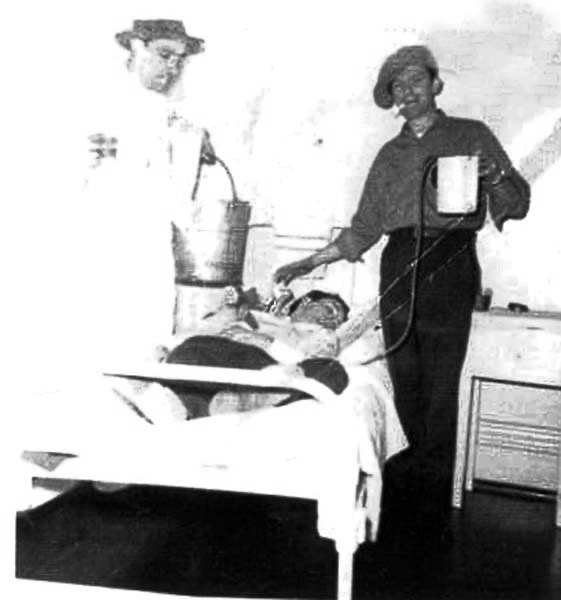
Chlorpromazine offered something different. Patients could become less agitated while hallucinations and disorganized thinking also receded. Many remained awake, could converse and could participate in care.
While scientific evidence would take years to accumulate, in the meantime, chlorpromazine spread rapidly. It did not help everyone and was far from benign, yet for some patients the improvement made discharge possible. Clinicians could see an effect, hospitals elsewhere reproduced it, and the drug was safer and easier to use than existing alternatives.
In 2005, a Cochrane review pooled 50 randomized trials conducted between 1955 and 2000, with a total of 5,276 participants. Despite the age and uneven reporting of many studies, the review found that chlorpromazine did improve global clinical outcomes compared with placebo. It also caused substantially more movement disorders, low blood pressure and sedation.
The drug that would “sell itself”
Rhône-Poulenc introduced the drug in France in late 1952 as Largactil, a name chosen to advertise its “large” range of activity. In Montreal, Heinz Lehmann, then clinical director at Verdun Protestant Hospital (now the Douglas Mental Health University Institute), first encountered it through a few French reprints left by a Rhône-Poulenc salesman who could not get an appointment. The salesman told his secretary that the evidence was so good the drug would "sell itself". In his interview with David Healy, Lehmann recalls finding the boast arrogant enough to read the papers in his bathtub. It proved an unusually productive bath. He began treating patients in May 1953 and published the first systematic North American series the following year, work that helped establish him as one of the founders of psychopharmacology.
In 1954, Smith, Kline & French introduced chlorpromazine in the United States as Thorazine and marketed it hard. American clinicians initially called it a “major tranquilizer”. Antipsychotic only became the common term in the 1960s, as the claims shifted from simply quieting patients to treating psychosis.
Like Rhône-Poulenc, Smith, Kline & French sold Thorazine as a “miracle drug”.
How Thorazine was sold
From paediatric nausea to social order.
“Primitive” beside “modern.” Source: Smith, Kline & French campaign, 1960s–1970s; discussed by Metzl.
1 / 7
One campaign placed African masks and ritual objects under the heading “basic tools of primitive psychiatry”. Thorazine appeared opposite as the tool of “modern” or “Western” psychiatry. Jonathan Metzl traces this imagery through antipsychotic advertising of the 1960s and 1970s, during the Civil Rights and Black Power movements, when American medicine and popular culture increasingly associated psychosis with Black hostility and political protest. The colonial argument in those ads was barely disguised. With Thorazine now available, psychotic agitation belonged to a “primitive” past.
When patients went home
Thorazine received U.S. FDA approval in 1954. Approval established that chlorpromazine’s benefits could justify its risks for a patient population. Yet each prescription reopened that question for one person. When treatment continued outside the hospital, someone had to obtain the tablets, remember the doses, recognize relapse, tolerate adverse effects and return when the plan stopped working. Sedation, rigidity and restlessness were no longer rows in a safety table. They affected whether someone could work, travel, care for children, sit through a conversation or agree to take the next dose. As discharge became possible, more of the burden shifted to families and community services that were not always prepared for it.
Chlorpromazine is often credited with emptying North American asylums. The timing makes for an appealing story, but gives the drug too much agency. In the US, public mental-hospital populations did not fall significantly during the first seven years after antipsychotics arrived. Instead, the sustained decline came later, alongside changes in federal policy, financing and patients’ rights (Pow and colleagues, 2015). Canada followed a similar trajectory. Psychiatric-hospital beds fell sharply from the 1960s onward, but part of that care moved into psychiatric units in general hospitals, a process Sealy and Whitehead, 2004 described as transinstitutionalization.
In West Africa, the situation was a bit different. Families were already central to psychiatric care, while access to mental health services was scarce. In Benin, for example, chlorpromazine has long been included on the national essential-medicines list, yet the WHO reported just 0.1 psychiatrists per 100,000 people in 2024. For many patients, getting treatment means first finding someone who can diagnose and prescribe, then hoping the medicine is in stock, and finally being able to return for follow-up despite the constraints of everyday life. This lack of access to specialist care is exactly what the WHO’s Mental Health Gap Action Programme (mhGAP) was designed to address, by bringing the management of psychosis into non-specialist care.
Availability was only one constraint. In sub-Saharan Africa, the drug entered communities where psychosis could also be understood in spiritual terms, and where people often had high expectations of treatment. A medicine that had to be taken indefinitely, without offering a cure, loses credibility quickly. In rural Ghana, Ursula Read found that families sometimes stopped antipsychotics after aggression improved, often for practical reasons. Weakness or persistent drowsiness could make it difficult to work, and fewer visions or voices did not always feel like much of a gain if the person could no longer function normally during the day. Sometimes improvement itself became the reason to stop: if the person seemed better, continuing to pay for tablets could simply feel unnecessary.
The drug was approved before anyone knew why and how it worked
In 1957, the Lasker Foundation honoured Pierre Deniker, Henri Laborit and Heinz Lehmann “for the development of chlorpromazine as a therapeutic agent in schizophrenia”. The drug was already part of routine psychiatric care and prescribed to thousands of patients and yet its molecular mechanism was still unknown.
The first useful biochemical clue came in 1963. Arvid Carlsson and Margit Lindqvist found that low doses of chlorpromazine and haloperidol1 increased the accumulation of 3-methoxytyramine and normetanephrine, products of dopamine and noradrenaline metabolism, without raising the levels of either transmitter. Promethazine, another phenothiazine which lacks antipsychotic activity, did not produce the same effect. Carlsson and Lindqvist reasoned that the drugs might be blocking the monoamine receptors, prompting an increase in monoamine turnover. They did not yet know which messenger, or which receptor was involved. In 1966, Jacques van Rossum hypothesized that dopamine receptor blockade was the mechanism of action of antipsychotics.
In 1972, John Kebabian, Gary Petzold and Paul Greengard showed that low concentrations of dopamine activated adenylyl cyclase in rat caudate tissue, and that chlorpromazine and haloperidol blocked the response. They suggested that this dopamine-sensitive enzyme might itself be the receptor everyone was looking for. That interpretation wasn't right. Adenylyl cyclase was not the receptor, but part of the machinery downstream of it. The assay’s pharmacology also failed to match the clinical potency of other antipsychotics. The dopamine-stimulated signal it was measuring mainly came from what we now call D1-like receptors, whereas antipsychotic potency tracks D2-like receptors.
Finding the antipsychotic target required an assay that could measure binding directly. It would be through the work of Philip Seeman's lab in Toronto that we would finally get a glimpse of the molecular mechanism linking antipsychotic drugs to dopamine. His team incubated brain membranes with high-specific-activity radioactive [3H]haloperidol, prepared with help from Paul Janssen, and measured which drugs could displace it. If chlorpromazine engaged the same pharmacological target as haloperidol, it should push labelled haloperidol away. It did, as did other antipsychotics and dopamine (Seeman and colleagues, 1975). Their result therefore pointed to a pharmacologically specific dopamine-binding site common to the two antipsychotics, rather than the drugs simply sticking to brain tissue.
The decisive link came in 1976. Solomon Snyder's team at Johns Hopkins and Seeman's team independently showed that, across chemically different antipsychotics, stronger receptor binding generally corresponded to a lower therapeutic dose in patients. The receptor identified by these experiments was later classified as the dopamine D2 receptor, and we now understand a bit better what blocking it does.
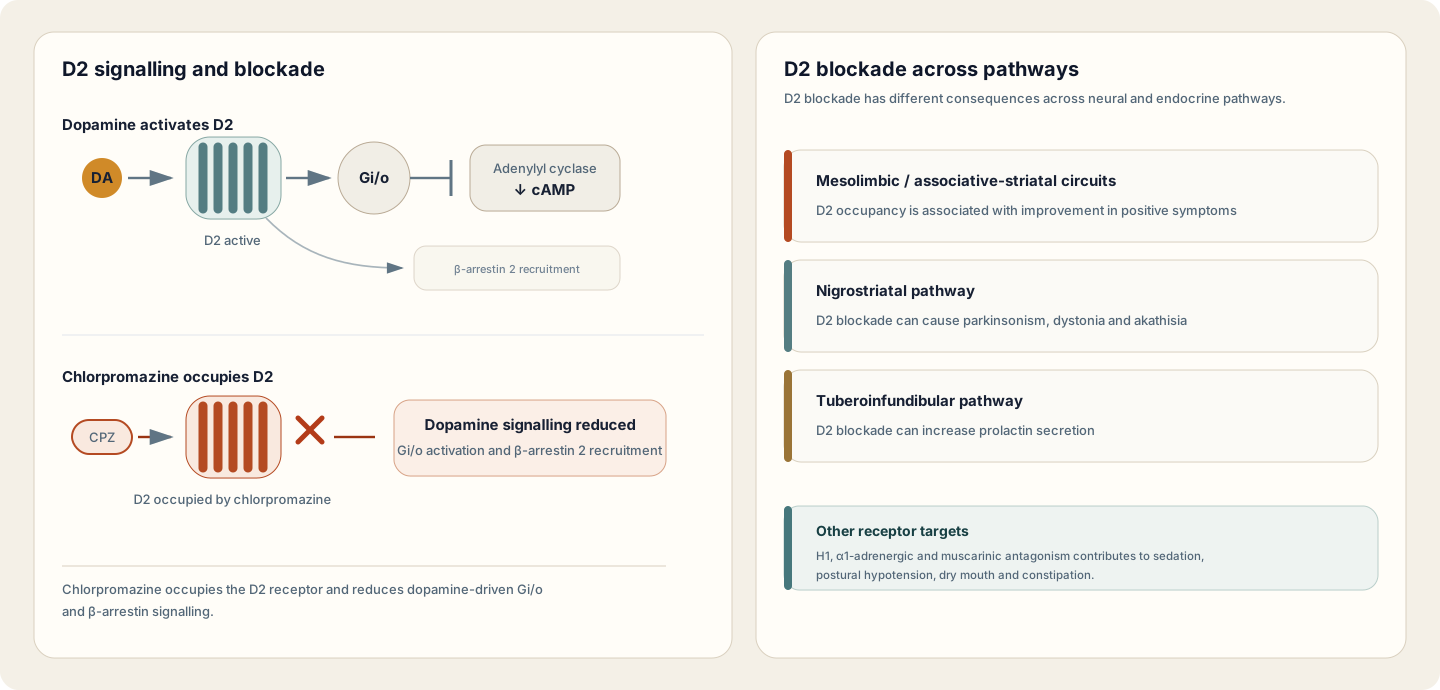
The consequences of chlorpromazine antagonizing D2 signalling depend on where that blockade occurs and which downstream pathways are engaged. In the movement-control circuit called the nigrostriatal pathway, D2 blockade can cause parkinsonism (stiffness and slowed movement), dystonia (muscle spasms) and akathisia (inner restlessness) (Kaar and colleagues, 2020). In the hormone-regulating tuberoinfundibular system, it can raise prolactin levels enough to disrupt menstruation, sexual function and fertility (Bostwick and colleagues, 2009). Chlorpromazine also antagonizes histamine H1, α1-adrenergic and muscarinic receptors, contributing to sedation, postural hypotension, dry mouth and constipation. The same pharmacology that made discharge possible could also make ordinary life outside the hospital harder.
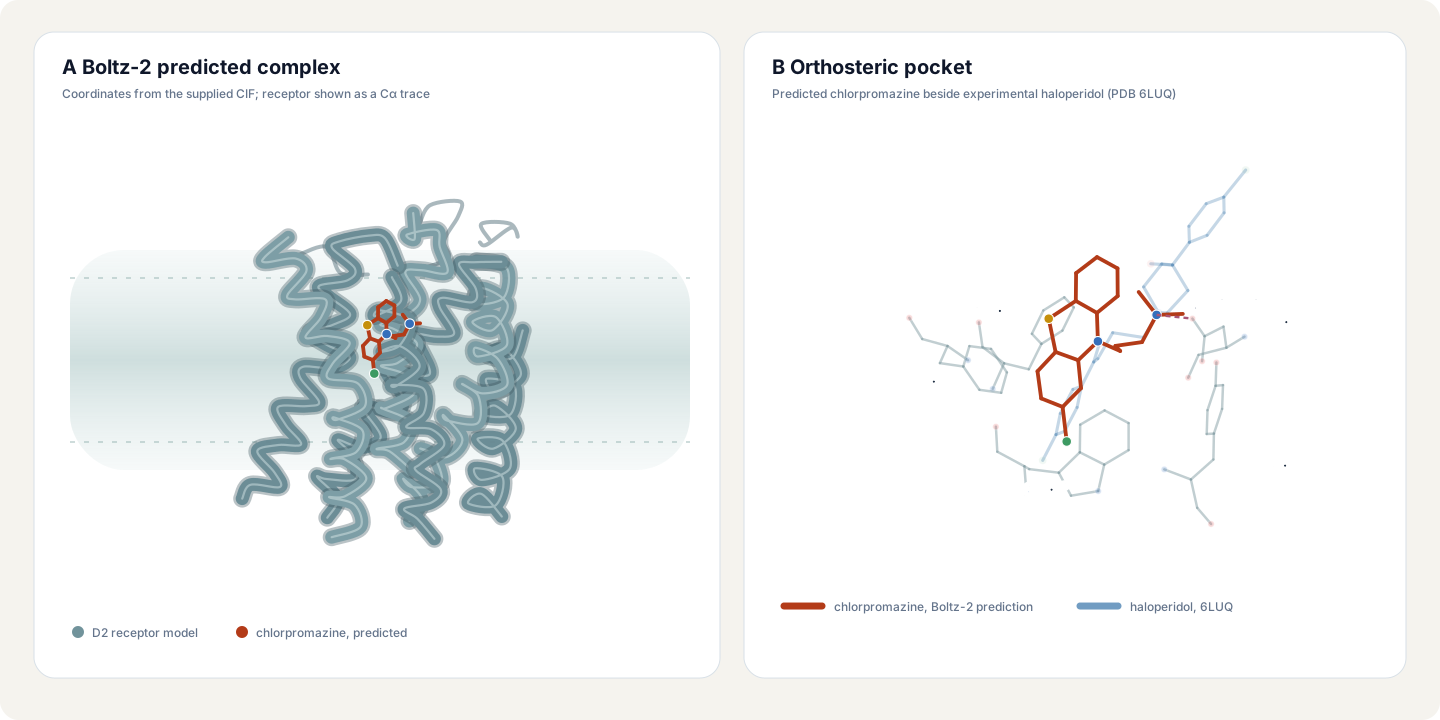
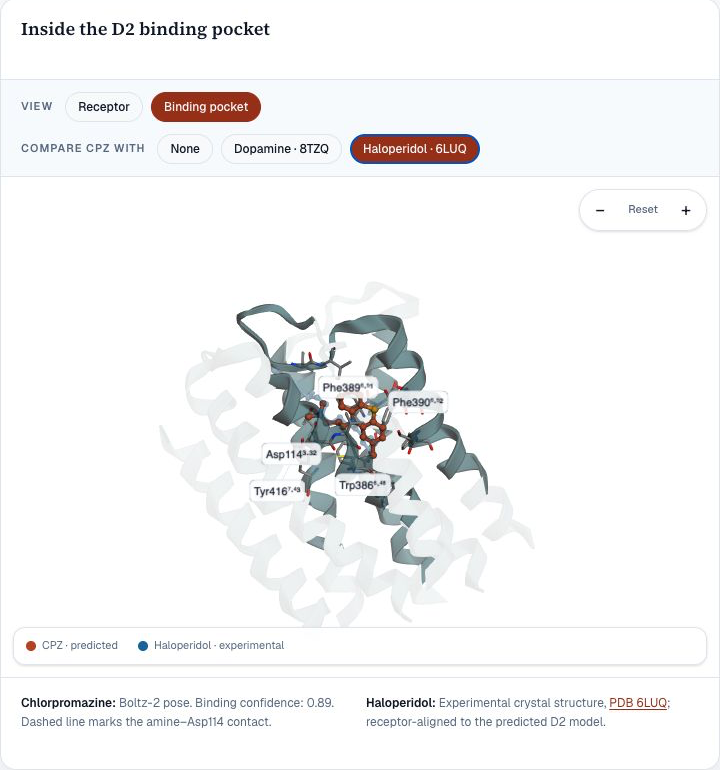
One question still remains: what does chlorpromazine actually look like bound to D2? To my knowledge, no experimentally determined chlorpromazine–D2 complex has been deposited in the PDB. Existing structures with haloperidol, spiperone and dopamine show the D2 binding pocket in inactive and active states, but chlorpromazine’s pose remains unresolved.
Modern AI-based structural biology models, including AlphaFold 3, Boltz-2 and Nesso-1, can now generate hypotheses about protein–ligand interactions, including binding poses and affinities. Boltz-2 places chlorpromazine inside the same D2 pocket as other antipsychotic ligands. Its protonated amine sits near Asp1143.32, the conserved ionic anchor also contacted by dopamine, haloperidol, spiperone and other D2 ligands. The orientation of the phenothiazine rings is less certain however. Without an experimental chlorpromazine–D2 structure for comparison, the pose remains just a plausible hypothesis.
How would virtual cells discover Largactil?
Imagine we are back in 1950, but with a much better understanding of molecular and systems biology than scientists actually had. 4560 RP is still one unsynthesised phenothiazine among many, and nobody knows what molecular mechanisms could relieve psychosis. Some omniscient being, known to dispense gifts of purpose without explanation, has just given humanity virtual cells. Could scientists have found chlorpromazine and worked out its mechanism faster? Better yet, could we find a better antipsychotic for patients like the one my wife was treating? One that preserves efficacy without asking them to carry the burden of side effects.
With infinite resources, the obvious temptation would be to brute-force the problem from molecular structure upwards. Take a large library of candidate compounds, predict plausible interactions with proteins, then propagate their effects through signalling and biological circuits until they produce something resembling a desired patient outcome. Luckily for our thought experiment, regulation in 1950 was permissive enough that any inconvenient uncertainty could be resolved by simply testing the compounds in patients.
An alternative would start with phenotype: screen compounds for interesting functional responses, then infer the biomolecular interactions that could explain them. Though at a different biological scale, this is much closer to chlorpromazine’s actual clinical discovery. In Virtual Cells: Predict, Explain, Discover, we argue that a useful virtual cell should work in both directions. Molecular models constrain plausible responses; phenotypic responses narrow the molecular explanations worth testing.
In either route, we would still have to decide what counts as a hit. “Antipsychotic” is not a cellular phenotype. A neuron does not hallucinate, and as far as I know, there is no validated cellular signature of a delusion. We could measure how a compound changes receptor signalling, firing, synaptic activity or gene expression in disease-relevant neural cells. Those readouts may help us rank compounds, but only if they are tied to outcomes beyond the dish. Psychiatry makes that connection unusually difficult: the effects we care about emerge from circuits, behaviour and, eventually, the life of a patient.
Suppose we find a cellular or biochemical response worth screening. We would still need to know whether the model had learned useful biology or taken a shortcut through chemistry. The next question would then be whether the desired response can be separated from the liabilities. A virtual cell could propose where that separation ought to hold, which interactions make it possible and what experiment would challenge the explanation most directly. This is what we mean by a falsifiable theory of biology. If every attempt at separation fails, we may have chosen the wrong phenotype, and it's still better to learn that before the compound reaches any patient.
Back in the present, I do think virtual cells can already speed up the search for better drugs. We have inherited decades of experiments and biological knowledge from the scientists who preceded us. We also have far more data and compute to throw at the problem than they could have imagined. Perhaps, that's truly enough.
This essay is a scientific and historical discussion, not medical advice. Antipsychotic treatment should be decided with a qualified clinician and should not be started, stopped or changed on the basis of an article on the internet.
Note
- Synthesized at Janssen Laboratories in 1958, haloperidol soon became a high-potency antipsychotic, particularly active against delusions and hallucinations. Its discovery and clinical tradeoffs deserve a Beyond the Assay essay of its own. ↩