Spasfon: What Happens When Familiarity Outruns Evidence?
September 12, 2026


In 2023, France reimbursed about 26.5 million boxes of Spasfon and equivalent tablets, on top of whatever people bought without a prescription. This drug is used for intestinal pain, renal colic, period pain, uterine contractions during pregnancy and most other pains that can be described with the word spasm.
I have taken Spasfon before. It's a pink-coated tablet, though mine was the lyophilisat white version. I didn't feel any relief, or much of anything really. And that did not make me suspicious in the slightest. After all, friends and family take it regularly and seem satisfied enough to recommend it.
In France and in Benin, where many of the same French medicines and brand names circulate, Spasfon is so ubiquitous that few ever question its efficacy. If you live in North America or any other non-Francophone part of the world, you likely have never heard of the drug. Neither Drugs@FDA nor Health Canada's Drug Product Database lists it, and in both countries you are more likely to find its active compound only sold as a lab reagent.
So why talk about it now? Because a recent debate around Spasfon has hardened into two positions. One side, backed by several recent studies, argues that it is no better than placebo. The other argues that surely the hundreds of millions of prescriptions, decades of use and countless "user testimonials" are evidence that it works. This conversation has also devolved into a broader and important discussion about women's health. And I will come back to that.
Objectively, and I want to be very careful here, Spasfon might relieve some pain or discomfort for some people. But I kinda want to believe the insane version of the story in which we may have accidentally been running one enormous, decades-long placebo experiment, with millions of people taking a drug they believed was effective, doctors reinforcing that belief through repeated prescriptions, and enough patients feeling better to keep the whole thing going.
What's in the pink pill?
The pink Spasfon tablet most people know combines 80 mg of hydrated phloroglucinol with 80 mg of trimethylphloroglucinol. Spasfon Lyoc, the freeze-dried formulation I took and which dissolves in water or under the tongue, contains phloroglucinol dihydrate alone. The injectable form contains 40 mg of phloroglucinol dihydrate and just 0.04 mg of trimethylphloroglucinol.
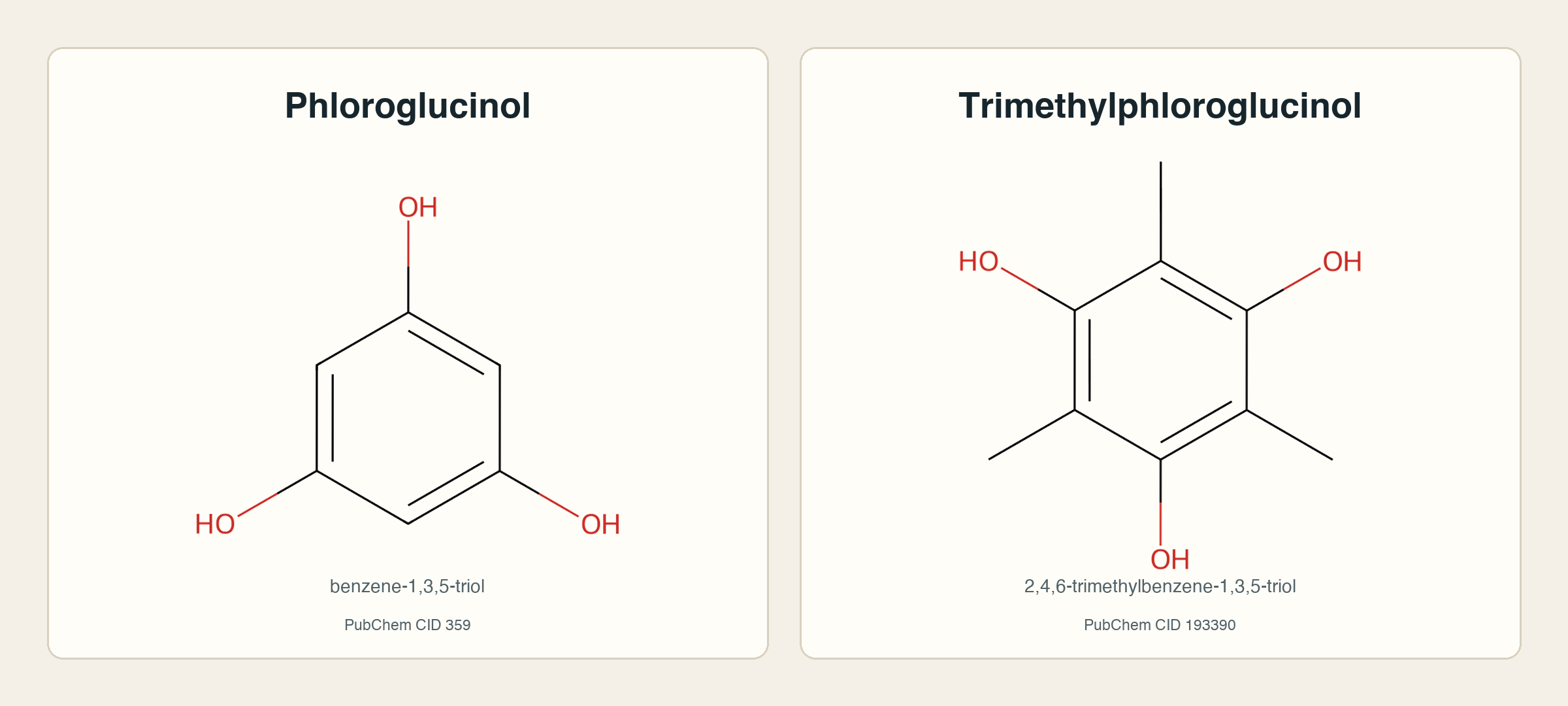
Phloroglucinol is classified as a musculotropic antispasmodic, meaning that it is thought to act directly on smooth muscle, rather than through the autonomic nervous system, to reduce spasms and the visceral pain associated with them. Its molecular mechanism remains poorly defined. Some reviews have proposed inhibition of voltage-dependent calcium channels and possible effects involving prostaglandins or nitric oxide, but no specific molecular target has been established.
A very French drug
In 1941, Louis Lafon took over a small pharmacy on rue du Faubourg-Montmartre in Paris, a few steps from the music cabaret Folies-Bergère. In the small rooms upstairs, he began developing and preparing medicines of his own, then officially founded Laboratoires Lafon in 1951. He found success almost immediately with Higalex, a drug for bloating and digestive complaints. Lafon reportedly went door to door to medical practices to sell it himself, eventually moving around 3,000 units a month. Higalex feels very much of its time. It combined extracts of liver and gallbladder, bile, artichoke, boldo and belladonna, a mixture of organ therapy and phytotherapy intended to stimulate bile. It would remain on the French market for four decades before being discontinued in 1992. Success brought confidence and more drugs. Lafon would follow in 1952 with Valfon, an antirheumatic, then in 1956 with Lysofon, for nose and throat complaints. The repeated -fon signature of his drugs was a nod to his own name.
In 1959, Lafon launched Vibtil, a preparation of lime-tree sapwood extract intended for “biliary migraines” and pain. By then the company had moved to larger facilities in Maisons-Alfort and Lafon had hired the pharmacologist Raymond Cahen to help build a proper research program. Together with their collaborator Charles Debray at Bichat Hospital, they were looking for better ways to treat "biliary pain" when phloroglucinol caught their attention. At the time, French doctors, perhaps still influenced by the humoral theory of medicine, spoke of "liver attacks" and "digestive migraines", linking digestive disturbances and bile to migraine symptoms.
Things moved quickly from there, and by the end of December 1959, a British patent application naming Louis Lafon as inventor had already been filed for pharmaceutical preparations containing phloroglucinol. Their first paper describing its use in humans was later published in 1961. It reported just 14 patients, ten of them women. In her history of Spasfon, Juliette Ferry-Danini reconstructed the experiment from the original paper and company archives. Patients underwent what the investigators called a choleretic-morphine test, in which they were first given a choleretic agent to stimulate bile secretion, followed by morphine, which can contract the sphincter of Oddi, impede bile flow and increase pressure in the biliary tract. The combination was used to provoke violent biliary pain, after which the patients received phloroglucinol and when that failed, the investigators sometimes reverted to the old lime-sapwood preparation. In some cases, they also gave phloroglucinol prophylactically before repeating the test, to see whether it could prevent the induced pain.
According to the investigators, this brutal procedure was meant to "avoid as much as possible the subjectivity of therapeutic judgment". But there was no placebo group, randomisation or blinding. Ferry-Danini, quoting the original case reports, describes one patient who developed fever, rash, nausea, diarrhea and headaches lasting several weeks, yet underwent the test twice. A second became too sick to return home. A third was described lying "in a fetal position" from the induced pain. In another case, the original authors wrote that the pain became "extremely violent" and that the patient contorted in bed. To their credit, they managed to standardize how pain was induced, yet the assessment of treatment effect remained unblinded and uncontrolled. Despite that, the study concluded that phloroglucinol was effective for hepatic and renal colic and its optimal dose was reportedly decided by the experimenters “after trial and error”.
If you find it hard to believe there were no better trial designs available in the 1960s, you are right. By the mid-1950s, rigorous controlled clinical trial methods were already well established and being reported in major international medical journals. The UK's Medical Research Council had already helped pioneer the modern randomized controlled trial with its 1948 streptomycin study, while by 1953 Beecher and colleagues were comparing morphine, codeine and aspirin with placebo in patients with severe postoperative pain using double-blind methods.
When Cahen published the animal and isolated-tissue experiments that would come to define phloroglucinol’s pharmacological identity in 1962, he reported that it relaxed smooth muscle both in vitro and in vivo. The effect was "highly selective", however, and depended on the organ studied and how the spasm was induced. Few studies later tried to replicate these findings, and none reproduced the same pharmacological picture with comparable clarity.
In 1963, Lafon submitted its application for a new drug called Spasfon to the French authorities. It joined the company’s now-familiar -fon line of drugs, with spas- spelling out its intended antispasmodic action. Spasfon reached the market the following year and Lafon started promoting it well beyond its authorized indications. His pitch was simple: if a pain could be described as a spasm, an antispasmodic sounded like the obvious treatment and Spasfon was one. Ferry-Danini found a late-1960s brochure aimed at medical students that mixed summaries of the scientific literature with promotion of Spasfon for childbirth. It recommended 18 suppositories per menstrual cycle and encouraged the use of Spasfon during childbirth, five years before the obstetric indication was formally authorized. Within a few years, around one million units of Spasfon were being sold every month.
Spasfon ads in France - 70-80s
Spasfon for the whole family: several generations gathered above four formulations of the same drug with the label: “a formulation adapted to every indication.” Source: Christian Hubert, Étude du concept visuel de la spécialité pharmaceutique : son impact sur la prescription médicale (1988), p. 71.
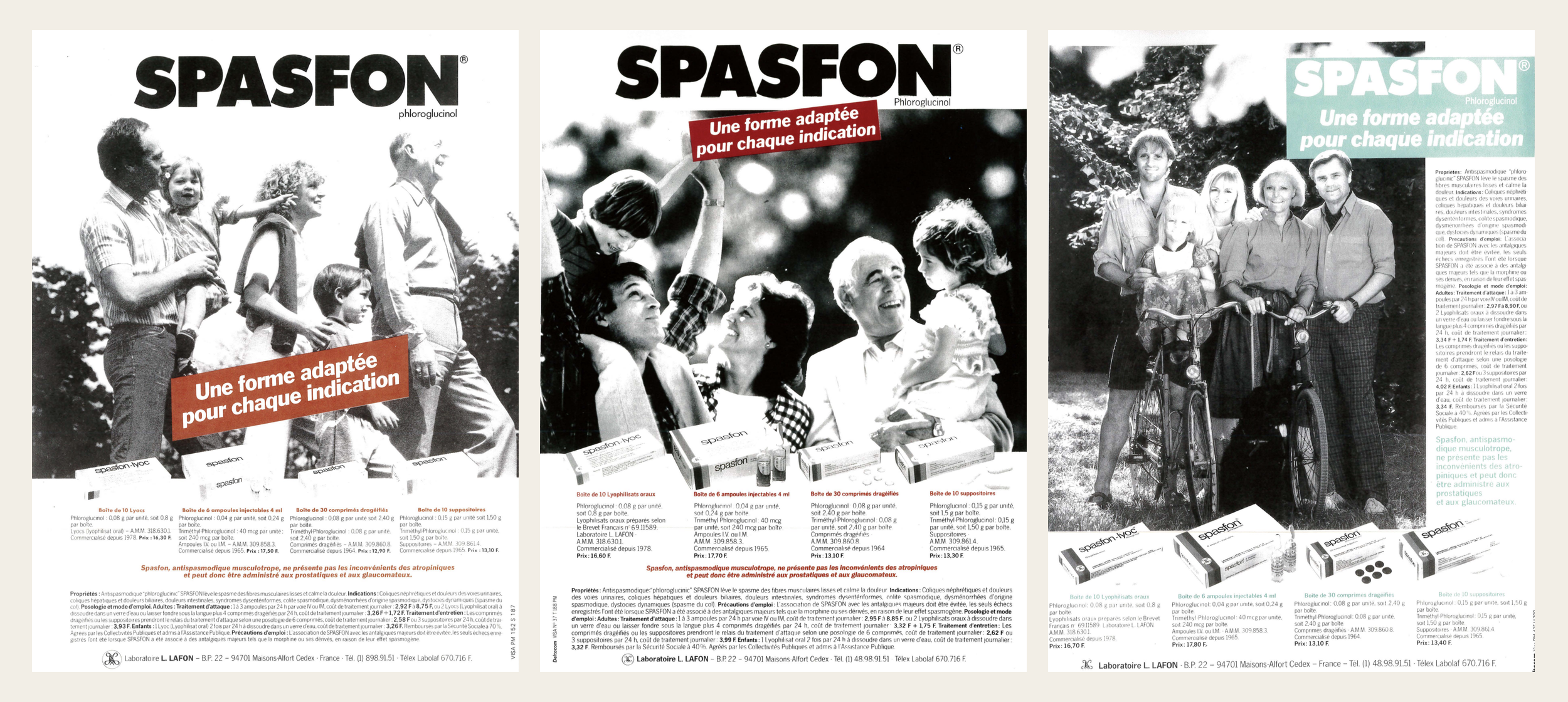
Nowadays, its indications include digestive and biliary pain, renal colic, painful spasms in gynaecology and contractions during pregnancy. The drug also travelled with French medicine. In Benin, and in several other former French colonies, phloroglucinol appears on national essential-medicines lists in oral, injectable and suppository forms. It's not, however, marketed as an approved drug in the United States and Canada. For primary period pain, US guidance recommends NSAIDs such as ibuprofen or naproxen and hormonal treatment. For renal colic, British NICE guidance recommends NSAIDs first-line and explicitly says not to offer antispasmodics. Canada does recommend some antispasmodics for IBS, but not phloroglucinol, and rates the supporting evidence very low quality.
What do the trials actually show?
There is at least some direct evidence that phloroglucinol can affect smooth muscle. In a 2021 randomized trial of 142 people undergoing unsedated gastroscopy, oral phloroglucinol completely suppressed gastric motility in 22.5% of participants, compared with 9.9% on placebo. Whether that translates into pain relief is a different question, however.
For abdominal pain, the best result came from a 2007 French trial in irritable bowel syndrome. After one week, 62.3% of patients taking phloroglucinol/trimethylphloroglucinol had at least a 50% reduction in pain, compared with 47% on placebo. But a 2018 systematic review judged that study at high risk of bias and found only three placebo-controlled trials in total. Pooled together, the evidence was not strong enough to justify the widespread prescription of phloroglucinol for abdominal pain. A later 72-patient trial in IBS-D again suggested a possible benefit, but narrowly missed statistical significance on its primary comparison. The largest modern test was not encouraging either: a 2025 US Phase 2 randomized trial of 421 patients with IBS-D tested CIN-103, a new phloroglucinol formulation, but was terminated for lack of efficacy compared with placebo.
For renal colic, phloroglucinol has mostly been tested alongside or against NSAIDs (nonsteroidal anti-inflammatory drugs), the recommended first-line treatment for acute renal-colic pain. A 2010 study found that adding phloroglucinol to piroxicam produced 71% pain relief at one hour, versus 70% with piroxicam plus placebo. A 2014 trial was somewhat more favourable: adding phloroglucinol to parecoxib improved early pain relief and reduced rescue analgesia, but not the final overall response. More recently, a 2026 trial of 258 patients compared phloroglucinol with diclofenac, also an NSAID. At 30 minutes, 55.8% achieved at least 50% pain relief with phloroglucinol, compared with 70.9% with diclofenac. The combination reached 74.4% and again was not deemed significantly better than diclofenac alone. Taken together, the combination-therapy results suggest that most of the pain relief comes from the NSAID, with phloroglucinol adding little overall benefit.
The evidence is even thinner in gynaecology and obstetrics, where Spasfon is widely prescribed. A 2019 systematic review of phloroglucinol for gynaecological and obstetric pain identified 12 trials, but only two met its criteria for placebo-controlled evaluation of pain, and one could not be obtained for critical review. The authors found insufficient evidence for labour, abortion and benign gynaecological pain, and no qualifying placebo-controlled trial for menstrual cramps. In the one study they could evaluate, 116 women undergoing first-trimester surgical abortion received phloroglucinol or placebo, with no significant difference in pain.
This is also where the debate around women’s health comes in. Ferry-Danini argues that Spasfon is not just the story of an old drug with weak evidence, but also one example of how women’s pain has historically been poorly studied and too easily normalized. How did a drug become routine for menstrual pain without clear clinical evidence? Even today, the French College of Gynaecologists and Obstetricians’ public information page lists phloroglucinol for menstrual cramps and describes the efficacy of antispasmodics as “certain”.
One reason this uncertainty around efficacy may have attracted less attention is that phloroglucinol appears relatively safe. A recent French study of more than six million pregnancies found no clinically meaningful increase in major congenital malformations associated with early-pregnancy exposure to phloroglucinol.
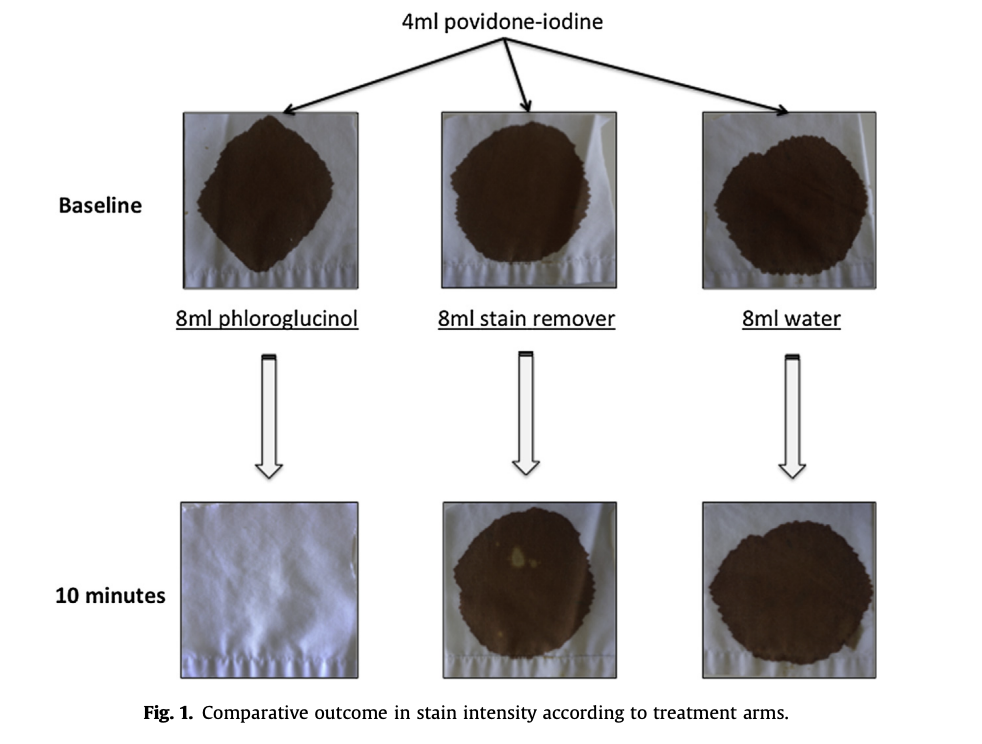
French obstetricians eventually answered with an unusually dry joke. In 2019, a Toulouse team published a randomized, double-blind experiment titled Finally an evidence-based indication for injectable phloroglucinol!. They cut a white coat into nine squares, stained each with povidone-iodine, then treated them with injectable phloroglucinol, water and a commercial stain remover. Phloroglucinol removed the stains better than either alternative.
What can we learn from Spasfon?
An uncertain mechanism is obviously not a reason to dismiss a drug as long as its therapeutic benefits are proven. Lithium still has no single agreed therapeutic target, yet it's a first-line long-term treatment for bipolar disorder. The same has been true for many drugs, including chlorpromazine, which I wrote about previously. The issue with Spasfon is the lack of clear evidence of clinical efficacy.
I do not need to tell you why we should not repeat the series of events that put Spasfon on the market with any new drug today. Science and regulation have improved enormously since the 1960s and we have much stronger requirements around both safety and efficacy. This has also made drug development slower and more expensive, sometimes frustratingly so.
It is entirely possible that some patients respond well to Spasfon, but that response should be defined and characterized prospectively, not attributed retrospectively. This is one area where AI could genuinely help, as models may identify biomarkers, predict responder subgroups or help design more informative trials.
However, the more powerful these tools become, the more important it is to separate discovery from validation. In his 2026 essay, Dario Amodei argued that AI could overwhelm a regulatory system built for a slower rate of drug development. He suggested that regulators should prepare to accept AI simulation or analysis for parts of the process, including toxicology prediction, dose selection, biomarker validation, synthetic control arms and surrogate endpoints.
I am sympathetic to part of his argument. If a model can reliably replace an animal experiment, an assay or part of a clinical trial, regulation should adapt. And it already is. The FDA has proposed a risk-based credibility framework for AI models used in drug submissions, while the FDA and EMA have published joint principles covering context of use, model risk, performance and validation. We at Recursion and Valence Labs also contributed to that broader regulatory discussion back in 2023, sharing our perspective with the FDA on how AI and ML should be used and evaluated in drug discovery and development. It is important, however, to distinguish (1) AI being used to decide what to test from (2) AI being used as a substitute for the test. I think most of my colleagues would agree that option (1) is a no-brainer. Option (2) requires a different standard of evidence, although sometimes the line is thin and in practice we have been navigating that boundary for a long time. Affinity predictors, for example, are routinely used to prioritize candidates and could potentially substitute for specific binding measurements.
Some of the rules that make clinical development slow exist because we learned, often the hard way, what happens without them. In an era of AI slop, no one wants an AI-slop drug, and stories like Spasfon should remind us not to cut corners.
This essay is a scientific and historical discussion, not medical advice. Persistent, severe, new or pregnancy-related pain should be assessed by a qualified clinician. Do not start, stop or combine medicines on the basis of an article on the internet.